The Grain of Thought
“The grain is the body in the voice as it sings, the hand as it writes, the limb as it performs.” — Roland Barthes, 1972
Over the past year:
- I have read more words generated by LLMs than written by humans.
- I have written more words for LLMs than for humans.
- And most of the work-related words I have written for humans have been LLM-mediated, passing under the editorial eyes of an LLM before reaching their recipients.
A truth I once assumed — “reading is how I consume writing” — has worn away, leaving something looser: “reading is how I consume text.” I no longer presuppose a thinking, feeling writer behind text.1 1 Some conceptual housekeeping: I realise this could be read as crudely smuggling in the argument that only people can write. Without opening an ontological can of worms, I think writing can be productively interpreted as one type of text production, characterised by the attempt to convey one’s thoughts. Other forms of text production might include transcription (by human or non-human scribes) and generation (by machines). So you’ll see me describe humans as writing and LLMs as generating.
Peter Steiner’s New Yorker comic, “On the internet, nobody knows you’re a dog,” comes to mind. Just replace the dog with a data centre.
This made me sad. Despite what my neglected reading habit might suggest, I am a writer’s son and a humanist before a technologist. One story I tell myself is that I value reading as an empathetic exercise, an opportunity for proximity with another’s mind as articulated through their writing. A nice, even romantic idea. And yet, there I was. A year of revealed preference undermining it, and I hadn’t even noticed. But then, given how LLMs are packaged, I’d be surprised if I had.
The default aesthetic of AI is one of helpful humanity. LLMs deal in “natural” language, trained on human words and fine-tuned using human feedback. We package them in chat interfaces — ones we associate with peer-to-peer communication — and give them “thinking” periods and streaming text, as if characters are being written onto the (digital) page. When they speak aloud, their voices are stuffed with the sounds of a body they don’t have.22 Laura Tunbridge (2016) identifies this pattern in the 2013 film Her, where Theodore falls in love with Samantha, a voice-only AI companion played by Scarlett Johansson. The plot’s success, much like the real-world acceptance of voice AI, seems to depend on our being able to imagine a body behind the voice. The choices behind Johansson’s casting and delivery reflect this — her recognisably husky voice cracking against her breath. During Samantha and Theodore’s first “fight,” she sighs, and the illusion breaks, prompting Theodore to ask: “Why do you do that? It’s not like you need oxygen or anything.” “I was trying to communicate,” she replies. “That’s how people talk.” Johansson later turned down a request to voice OpenAI’s Sky model, then threatened legal action, alleging the company had modelled it on her vocal likeness anyway. The presentation of human written text is almost flat by comparison, standardised to be portable and legible across screens.
Semantically, I can sensitise myself to the quirks of human writers, the residues of them-ness in text. But the processes of writing and thought are visually erased; little survives beyond the occasional “Asker is typing…” indicator. Meanwhile, the machines are moving the other way. In ChatGPT’s Group Chats, the model displays “ChatGPT is typing…” and sends a complete message, like a human, rather than streaming its response. So, between streamed “thoughts” and simulated typing, LLM generation now offers as much visible proof of a thinking entity behind the text as human writing does — if not more.
Models perform cognition in ways we can see; human thought stays hidden inside heads, inferred only from the finished text they leave behind. There is no perceivable extra-semantic difference between digital text I conscientiously laboured over and text I thoughtlessly spewed out.
My first reaction to this was relief. I suspect the “process anonymity” of text protects us from many a scandal. My second, though, was curiosity: human draftsmanship had silently disappeared from what I read — what if text preserved the process of writing?
If I could better distinguish written text from generated text, maybe I would have felt its loss. I would have better engaged with the human behind what I read. I would have appreciated the time they had taken to write something in our age of near-infinite generation, and felt whether their words came to them easily or whether they fought for them.
A literature review, kind of
I'd already encountered this question — what’s communicated beyond what’s said, by the body in the act of communicating — in another medium: music. The French literary critic Roland Barthes asks it of singers in his 1972 essay, The Grain of the Voice.33 Barthes was a man of letters who wrote about music. I’m a musician writing about text. It made sense we’d cross paths.
Barthes’ problem is that music criticism is adjectival. Critics describe music as having qualities (the song was luminous, tender, expressive). But music, Barthes insists, isn’t an object with qualities. It’s an event, an encounter, something that acts on us. The adjective replaces the particular encounter with generic, non-musical language, and puts the critic at arm’s length. There, Barthes claims, we are protected from music’s power to undo the self, when being undone is precisely the point. This is maybe a tad dramatic, but packaging a musical experience into words changes our relationship to it.
Typed text does something similar. It flattens the events of writing and thinking into an object — a document, email, tweet — whose appearance is only tangentially related to how and by whom it was made. Process anonymity in text is a choice to prioritise portability and legibility over the human-to-human connection of reader and writer. This may well be a valid trade, but we should know the cost.
For music, Barthes does not think we can simply pick better adjectives. Instead, we must “change the musical object itself.” He transposes Julia Kristeva’s geno-text/pheno-text distinction, dividing a song into two component parts:
- The pheno-song. Everything in the performance that serves communication — its lyrics, style, interpretation. Everything we tend to address through adjectives.
- The geno-song. The bodily process of vocalisation (or music-making, generally). The friction of the throat against language, the specific way a particular singer’s vocal tract collides with each vowel and consonant.4 4 Why use Barthes’ pheno- and geno-song when talking about writing if Kristeva came first? One: it’s how I encountered the concept. Barthes was required reading in my first year of undergrad. Two: their “geno-”s get at different things. Kristeva’s is concerned with the signifying processes of language itself: rhymes, rhythm, syntactic gear changes. Barthes’ is the body in the mechanical processes of communication. I inherit the latter, transplanted back onto text.
Barthes argues that we can appraise music, while preserving its nature as an event, by listening for the geno-song and attending to music as an encounter between bodies. The critical criterion for great music, under this lens, is whether we can perceive “the body in the voice as it sings, the hand as it writes, the limb as it performs.” Barthes calls this “grain,” a perceivable manifestation of the geno-song. To me, it’s a record of there being an embodied creature on the other end of communication — someone who will only sing so many songs and write so many words in their short, short life.
Conceptually, this is what I felt I’d lost when reading was separated from human writing. Practically, however, nothing changed.
Over the next few days, my reading was occasionally punctuated by the thought “someone wrote this,” or its inverse, in a relatively apathetic, adjectival manner. I suspect this was also true of any nerdy music critics after reading Barthes’ essay. It’s been over 50 years since The Grain of the Voice, but music criticism hasn’t undergone an “embodied turn,” reshaping itself around the grain — certainly not outside niche academic circles. Even Barthes’ own writing falls back on pheno-song-like descriptions and adjectives (“the purity — almost electronic, so much was its sound tightened, raised, exposed, held”). This is a paradox of geno-song criticism: the communicative, generalising, objectivity-coded goals of criticism undermine the specificity of embodied musical encounters. Bluntly, geno-song criticism just isn’t very valuable.
However, I also remembered that my goal was never to critique writing. I’m trying to feel it differently — to make humanness legible in text and enable the encounter, not to describe it second-hand. This is partly a conceptual problem, but it’s also a matter of medium and medium literacy. The medium, at least, I could redesign. So, I returned to my question — what if text preserved the process of writing? — with newfound specificity: how would I reimagine text to capture the grain of thought?
Much like my conceptual frame, my criteria came from music. I spent a decade, from age 12 to 22, as a choral scholar in cathedrals and chapels, singing alongside (and listening awestruck to) some frighteningly good singers. My most memorable listening experiences seem to have two things in common.
First, a heightened sense of temporality — the liveness of a musical moment and our aliveness in it. Whether I lose track of time or become hyper-aware of it, an engaging musical encounter often feels like a “moment.” After all, it is absurd, and therefore special, that living beings come together to produce and share beautiful sounds that are unnecessary for survival.55 “Unnecessary” might be too harsh. Evolutionary theories of social bonding would hold that the cohesion and coordination music affords outweighed the danger of making noise that could expose our ancestors to attack. The point stands that it is weird, and beautiful, that we sing and dance — and I’d rather not treat that as trivial. Perhaps this is Barthes’ point: true connection with something beyond ourselves makes our mortality legible — either in the moment, or after it, when the absorption breaks, time resumes, and we find ourselves again, finite as ever.
Second, an awareness of human striving. I experience a hand-me-down thrill when observing incredible feats. It could be a soprano opting up to a stratospheric high note or a bass navigating coloratura — rumbling but dainty, like an A380 performing aerobatics. These extremes are moments where labour becomes salient, either as the performers’ present-day effort to mitigate executional risk and protect their reputation or as the years of practice that justify that reputation. I suppose I am describing an attendance to effort, and the ever-present risk of failure that demands it.
These two ideas — mortal finitude, and effort amid uncertainty — are not limited to music. I think they are essential to our best communicative experiences, the ones where we are doing something costly and vulnerable. And yet they seem to have been progressively devalued in written media.
The invention of writing traded the embodied encounter — temporally finite, rich in vulnerability — for semantic portability. Using shared symbols, we replaced chains of co-present meetings with artefacts that travelled, semantically intact, across time and space.
For a long time, human finitude and effort remained obvious in the artefact. A letter is personal because of its clumsy, tactile production: the quirks of a writer’s penmanship, their crossings-out, their marginalia. Any smudged ink came from contact with their specific hand. This proximity eroded with the printing press, the typewriter, and the word processor, which left text effortlessly appearance-agnostic and process-anonymous. Whether this draft — which I assure you has not come effortlessly — or an online edition of Barthes, Arial is Arial, and I cannot tell whether these letters only just appeared or have always been there. And now even this flatness is losing its stability, as every piece of text carries a human-machine question that never existed before: a handwritten letter can contain an LLM’s words.
None of this is an argument against printed or digital text. But in our devotion to semantic portability, we carried the technical limitations of the printing press into digital text and never recovered what we gave up along the way. Digital writing could show the grain of thought. It just doesn’t yet. So, I tried.
Experiment 1: The artefact as event
My first idea was to turn the artefact into an event. As a kid, I used to post “speedpaints” on YouTube — timelapse videos showing the creative process behind a painting or illustration. While mine were never much good, and are thankfully long gone from the internet, there are plenty of high-quality speedpaints that show the evolution of a piece from initial sketch to final illustration. 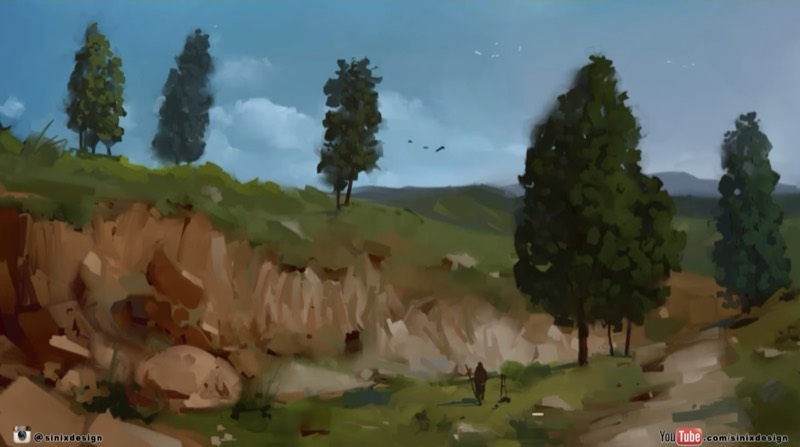
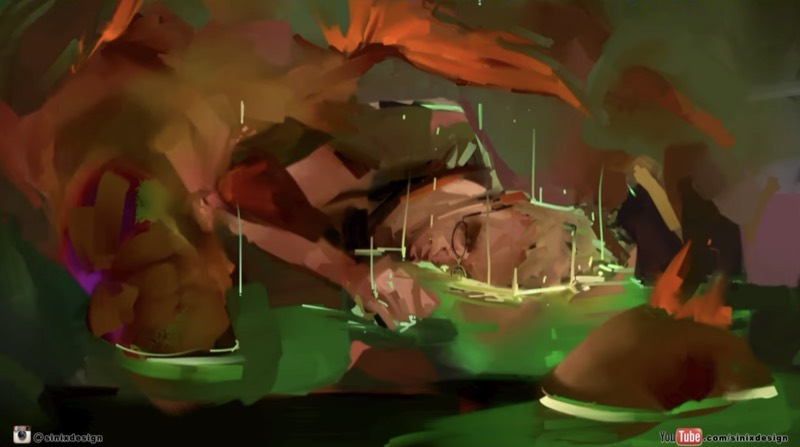 the same canvas, painted from a landscape into a figure. stills from Sinix Design's Paintsploration?! [Vol. 2].I particularly enjoy Sinix Design’s Paintsploration series, in which he repeatedly paints over a digital canvas, taking shapes from one image and morphing them into another. In minutes, you watch a multi-hour journey from a pastoral landscape to a realistic human figure strewn across an abstract pool of nuclear-green liquid, separated by a theatrical pitstop in a hellscape and a brief visitation from a baby dragon. These scene changes involve the deformation, and often total destruction, of the prior image, transforming art from a noun into a verb. Through timelapse, art becomes an encounter, a performance of process. I imagined something similar for text: a new medium of writing performances, like tweets that showed the process of writing. Before I touched code, I tested this by recording the process of typing and watching it back sped up. A speedtype, if you will. For all my excitement, the results were not especially compelling, for two clear reasons.
First, writing only really makes sense once complete. Where paintings often start with their composition, and thus have legible intermediate states (“the big picture” can exist prior to the details), even rough drafts of writing are constructed at the level of the sentence. A half-written sentence is just broken. So, playing with speedtypes, if the recording was too slow I would wait on words, frustratedly predicting them; if too fast, I found myself racing to keep up and to understand anything that got deleted. In both cases, I was spending more energy trying to parse the (now dramatically less legible) pheno-text, without being able to latch onto the geno-text with anything other than annoyance.
Second, the unique affordances of speedtypes turned out to be, ironically, more pheno-textual than geno-textual. Recording the process of writing has serious trade-offs: it breaks down the private-public distinction necessary for free exploration, and it constrains how I wrote. It also changed what I wanted to write, becoming a performative vehicle for pheno-text. I considered the poetry one could write in the first pass before changing a word or a sentence to invert its meaning. Interesting, but not what I was looking for. I wanted to convey the grain of thought as it appears behind the writing we already do — not to create a new kind of writing performance that exploits the visibility of that grain.
Barthes might lament it, but I realised I needed to sacrifice the event and let semantic content exist undisturbed and in full, so that we could look beyond it. This ruled out unclear layouts, flipbook-style animations, and illegible transformations of the text.
Experiment 2: Typography
How might I vary the static appearance of text to imbue it with meaning? I set my sights on typography.
Typography conveys subtext. Your decision to use a sans or a serif on your CV says a lot. (I am a reformed sans user, myself.) That said, much of our typography is passive. Font choice acts as a static, pheno-textual scene-setter, while variations like boldness and italics carry fixed semantic associations. I wanted something visually distinct, flagging another layer to the text.
I initially considered the type foundry NaN’s Glyph Filters — a few dozen Python-based algorithmic filters you can apply to any font to completely transform its appearance. These had the benefit of being striking yet legible. But the filters — named things like Distressed, Glitch, and Bubble — carry obvious pheno-textual connotations that would either be read as word-painting (enforcing the semantic content of the text) or as incongruous, rubbing up against it in a distracting way.
So I turned to Recursive, a font by ArrowType that can be transformed simultaneously across five continuous axes: monospace, casual, weight, slant, and cursive. These felt neutral and expansive enough that I could attribute a different behaviour to each axis. I started with two, building a tiny HTML text editor that reflected typing speed through character weight — slower writing meant heavier text — and increased casualness depending on how many times a section had been reworked.
Something clicked. As I tested the program, writing short notes and haikus, I developed an intuition for how different writing experiences were translated visually. So when I let friends try writing with it, I could sense certain event-like qualities behind the text: where their next words were still forming, what had been a typo and what had been a rewrite, which sentences emerged fully formed and effortless, and which had to be chiselled from the mind. The pheno-text was legible, but laced with process.
It wasn’t perfect, though. First, even pushed to its extremes, an incremental step in casualness was not very perceptible — and, worse, the perceptibility of casualness varied across characters (a casual “o” in Recursive is less striking than a casual “m”). Second, the reservations I had about word-painting with NaN’s Glyph Filters mapped onto Recursive’s casualness too: there isn’t an intuitive answer for whether something should become more casual as you erase over it (text growing messier with process) or less casual (text growing more refined). Finally, given how pheno-textual font choice can be, I didn’t want to constrain myself to Recursive. In fact, the font was the wrong unit of design altogether. Recall the handwritten letter. Its humanity lay as much in the page — the crossings-out, marginalia, and ink smudges — as in the letterforms.
Experiment 3: The hand as it writes
I don’t handwrite much these days. I remember being a kid in the mid-2000s, watching adults fill out paper forms and make self-deprecating jokes about how little they handwrote anymore. As a seven-year-old, working hard to earn my “pen licence” at school, I was furious they didn’t recognise the privilege they had. Now one of those adults, I clumsily picked up a biro.
Words. Anything.
Lines of pigeon-scratch from a hand long out of practice. I read it back with the act of writing still fresh in my body. The pheno-text: just words. Mostly nothing. But beneath them and within them, I caught myself, like a voice from a choir. A misshapen character hastily captured; ink pooling where I paused to think mid-penstroke; scribbled crossings-out; words crammed in between lines. These marks of draftsmanship — residue of “the hand as it writes” — became the blueprint for my final experiment.
I landed on five mechanisms.
Writing speed. My scribbles betrayed a tempo. Uncertain, my letters started neatly formed and stiff, gradually accelerating into light, flowing lines as my thoughts ran freely from mind to hand. I could sense where this flow broke, where I had paused and restarted or caught myself in mental mud. This was the major success of my second experiment, so I preserved it, varying character weight to reflect typing speed — the labour of each letter pressed into the text. I tuned it a little, so the weighting felt responsive but not unwieldy.
Erasing. This was the most obvious process residue in my handwriting test: correcting slips of the hand and rewritings of the mind, I would bury my mistakes under harsh lines. In Experiment 2, I used Recursive’s casual axis to show how many times a word or character had been rewritten. I was convinced this was the right mechanic to track, but the wrong representation. I considered borrowing strike-throughs from handwriting, but I knew from my speedtypes that I didn’t want to show pheno-text the author had sought to remove. So I went back to my pre-pen-licence days. When you write with a pencil, the eraser smudges the graphite and leaves residue that builds up the more you rewrite and erase; do it enough and you wear away at the paper fibres themselves. The pheno-text is removed, but the breakdowns of the mind-hand-page connection remain visible — the physical artefact elevated to medium in the act of writing. I let the page capture this with a grain effect that builds up the more you erase over a section. And, since digital text can move around the page, I decided the residue should travel with the words it was once attached to. The word on the page is a more accurate marker of when and where a typo happened than the literal page layout.
Insertions and rewrites. Part of why speedtypes failed was my belief that writing is linear. That’s true for me at the sentence level. But on a longer draft, linearity looks more like loops — I go back to rework a section or add a sentence, before returning to the cliff edge that separates my draft from the blank page ahead. This is more common when writing digitally, where space is endless. In my scribbles, by contrast, any insertion was crammed above or between lines, indicated by a caret or a line pointing into the marginalia. I wanted to retain the editorial freedom of digital text but capture the sense of constraint that came with a handwritten rewrite. I considered literal carets, but, given that we’ve become accustomed to rewriting whole pages, I opted for something less disruptive: raising the text and shrinking it for each looping insertion. Since regular deletions were handled by the grain effect, I gave characters a short grace period in which you can fix minor typos. After that, any text you insert before your draft’s cliff edge appears raised and squashed; go back to a rewritten section again and it nests a little higher and shrinks a little more.
Writing across sessions. I am a slow writer and — as anyone who has had the displeasure of speaking to me while I worked on this essay can attest — when I write, my life becomes the drafting process. My pacing around the office, my staring at the ceiling, my duck-dives into the Notes app mid-conversation are as much “writing” as me sitting at my laptop with music on and fingers typing. Yet all of this is hidden in the artefact, whether handwritten, printed, or digital. We read things as pre-existent, finished objects, but writing takes someone’s time. At best, ink can hint at this. Over short time scales, we can tell fresh ink from dried. Longer-term, we can tell when ink has faded from years in the sun. I borrowed this, letting text gradually fade between sessions — never so much that legibility was at risk, but enough to look settled, established.
Pasted text. With these four mechanisms, I felt I’d captured some of the process residue we gave up with the printing press and never added back. But I hadn’t accounted for everything native to digital text editors. In particular, pasted text. My instinct was to block it altogether: you could type any text you wanted to paste, as you would when handwriting. That felt wrong, though. The goal was not to recreate handwriting, but to make the embodied processes of thought and writing visible in text. So I enabled pasting, initially rendering pasted text as flat and uniform. I couldn’t fabricate labour that didn’t happen here. But that wasn’t right either: it made human-written text feel abnormal. By then I’d added some basic formatting controls, including a toggle between a sans and a serif, so I settled on a mono font for pasted text. I’ve since gone back and forth on the pheno-textual implications of a mono — fonts I associate with code — but it seemed the clearest way to demarcate a difference in provenance, and choosing a typewriter-like mono (Menlo), rather than a terminal one, softens the association. To distinguish externally pasted text from internally cut-and-pasted text, I made sure the latter retained its grain.
Grain
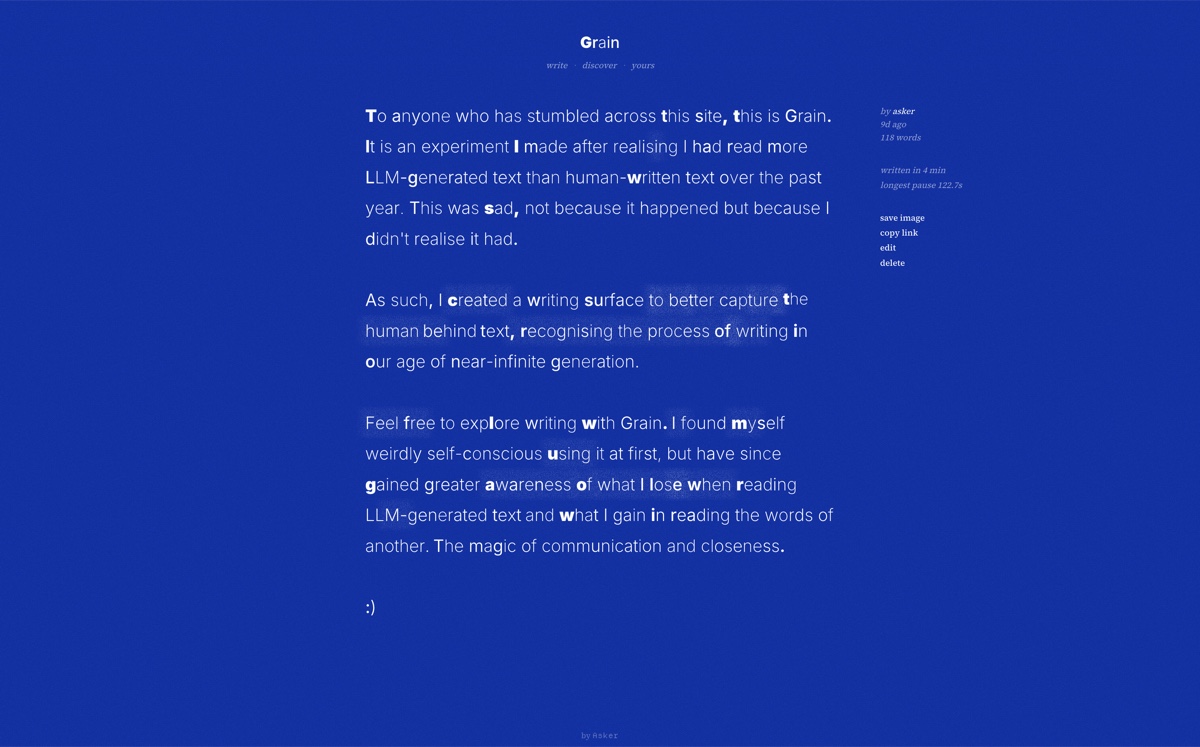 a note written in GrainNamed after Barthes’ essay, Grain is a text editor designed to better capture the grain of human thought. It renders the physical processes behind writing: the micro-pauses between words, the typos and rewrites, the non-linearity of drafting. You probably shouldn’t write your emails with it, but it represents an idea that deserves our attention in the age of infinite generation. It exists to confront us, the readers, with the fact that these are the words of a person who deemed writing this text a worthwhile use of their limited time and resources — a person who had a thought and tried to communicate it, who tried to be understood, who tried to (and maybe did) connect with you.
I don’t think it is Luddism to find this valuable and worth preserving. I am excited by the new ways we can use LLMs, and other forms of AI, to connect with each other. But I also think it is far cooler that we, living beings, can have and share ideas in the first place than that our machines can simulate doing so.
I hope you’ll experiment with Grain, but I’d also like to briefly flag what I take to be its conceptual instabilities and shortcomings.
While heavily inspired by his work, I suspect Barthes would have been unmoved by, if not entirely opposed to, Grain. In a 1973 interview for Le Monde, he disclosed a near-fetishistic interest in writing materials: pens, nibs, ink, paper. As the essay’s opening quote implies (“the hand as it writes”), he viewed writing as synonymous with the physical act of handwriting, using a typewriter only to transform a finished product for mass distribution — a necessary compromise after the drafting process. Use the typewriter too early and you prematurely give the text the appearance of being settled and complete. Since very few people draft with pen and paper, I think Grain is an improvement, by Barthes’ own lights. But, given that computer keyboards strip almost all the grain from writing, his question would be: why not just handwrite?66 I have a crude impulse to argue that a grainier typed medium increases the total grain in circulation: modest grain at mass scale beating high grain that almost nobody encounters. Consider this restraint. It’s a clumsy, tactile process, and it quickly reminded me of the time and effort writing involves. Maybe that clumsiness, that “friction,” just is grain. Still, there are traces of the body in keystrokes — enough to let us treat the keyboard like a MIDI instrument for prose. And since typed text is most people’s native medium for reading and writing, it felt worthwhile to investigate what geno-text might exist there. It is heartening to remember: we can design mediums if we find them lacking.
This connects to a conceptual issue. I’ve been somewhat lax in swapping between “writing” and “thinking” — most obviously in this essay’s title, the grain of thought, rather than of writing, or even of typing. In short, I think there’s probably some Heideggerian argument to be made about the keyboard as an extension of a fluent typer’s body: when fluently typing, the keyboard dissolves into the activity, and, given how fast typing is, that activity often feels as much like thinking as like writing. Thinking and writing become commingled. Thinking-writing, perhaps. Either way, the unit of pheno-textual output is a symbolic representation of thought — otherwise called text, or writing. (Also, I just liked how it sounded.)
Finally, what Grain is not. It is tempting to read it as a provenance technology — proof of humanness, a watermark for the age of generation. It isn’t, and it couldn’t be: everything Grain renders can be faked. A model with tool access could type with hesitation, rework its sentences, leave convincing residue. Grain is an attention technology, not a verification one. It changes what a reader can perceive and what a writer is invited to notice. The point is not to make readers paranoid, scanning every text for forgery, but to make them sensitive: to restore the assumption that there might be someone there, and the habit of looking. I’m genuinely curious what fluencies Grain, or other grainy media, might enable. In that spirit, and at the request of some curious friends, I’ve added light sharing. Everything you draft is stored locally. But, if you feel so inclined, you can publish a note or read the published notes of others. Again, probably not the place to write your magnum opus — if only for my cloud-storage bills — but I look forward to reading what you write. Pheno-text and geno-text alike.
Picking up an old plank
I think we perceive things as having changed overnight more often than they actually do. It feels that way because, like Theseus’s ship, things change quietly and gradually, one plank at a time — until, suddenly, we’re swapping out the last of the originals. We can all see how we got here; we may even have been the ones removing and replacing the planks. But it’s still reasonable to step back and think, “Hold on, where’s the ship gone?” Or, more pressingly, “When did we agree to get rid of it?”
LLMs did this to me as they rewrote my definition of reading, without my ever considering that the definition could change. There are no lifeguards watching for people at risk of phenomenological drift. But if there is something we value, design is one way to engineer its visibility. Grain, to that extent, is a planted flag: a statement that I value the living, thinking, feeling being on the other side of the words I read, and the encounters that reading makes possible.